
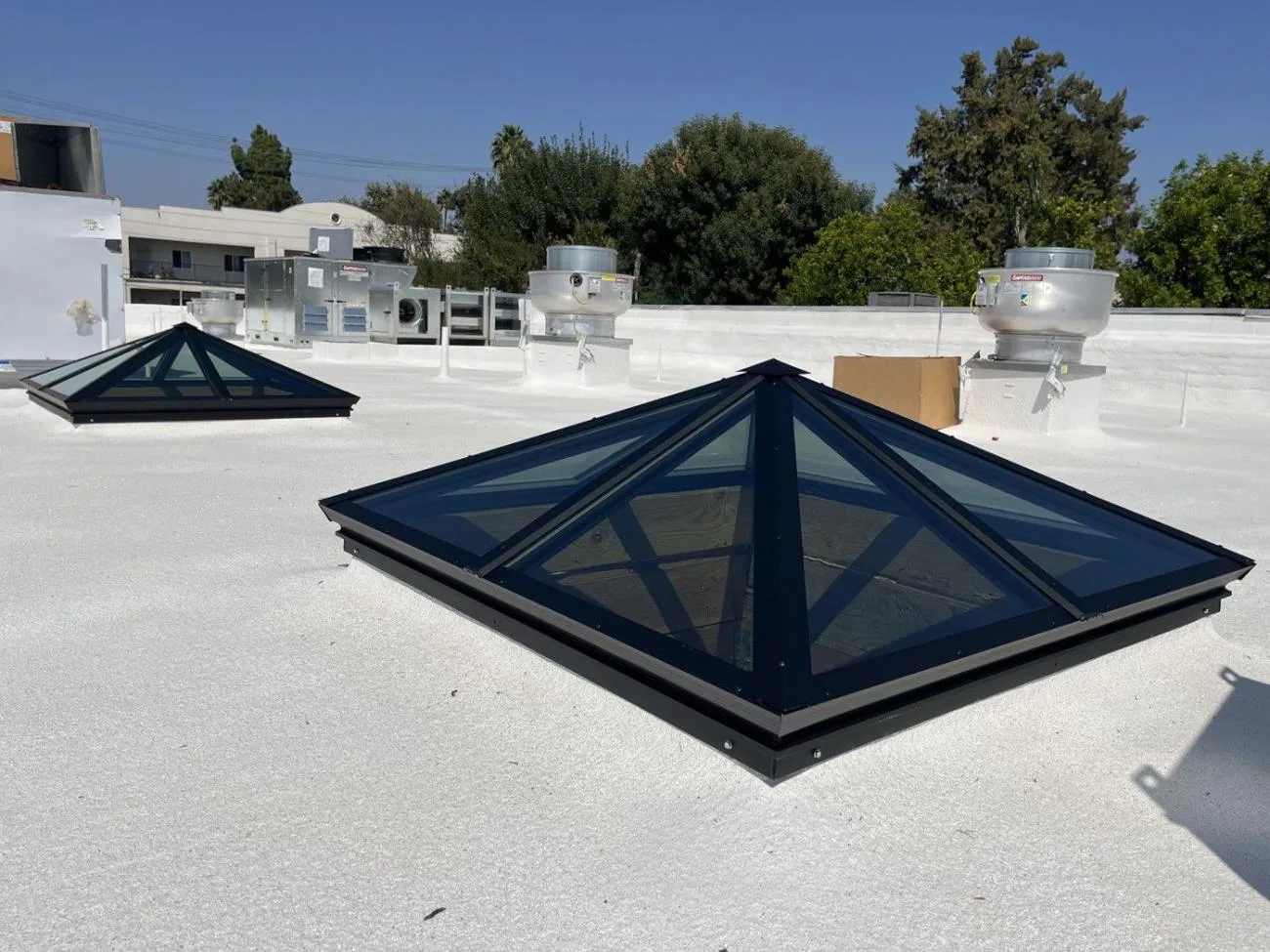
The honest answer to “what does a skylight cost” is: it depends, and anyone who gives you a single number sight-unseen is guessing. But that is a frustrating answer when you are just trying to budget, so here is how skylight pricing actually works, what drives it up and down, and the questions that determine your number.
What actually drives the price
Two skylight jobs on the same street can cost very differently. Here is why.
1. Repair, glass replacement, or full replacement
These are very different price tiers. A glass-only swap, possible only on custom architectural skylights that can be field-disassembled, is the least expensive when it applies. Replacing a whole skylight unit costs more, and is the only option on factory-sealed VELUX and dome skylights. A new installation where there was no skylight before is more again, because it involves a new roof opening, framing, and drywall. Knowing which one you actually need is the biggest single factor. See repair vs. replace.
2. Glass versus acrylic
An acrylic or polycarbonate dome is the economical option. A glass skylight costs more but stays clear for decades and does not yellow. The jump from plastic to glass is one of the bigger line-item differences. See glass vs. acrylic vs. polycarbonate.
3. Fixed versus venting
Fixed just means it does not open, glass or acrylic, it is simply the unit that lets light in and stays closed. It is the simpler, less expensive option. A venting skylight opens, especially a motorized or solar one, and costs more for the unit and the setup.
4. Standard size, special size, or custom architectural
A standard-size unit off a manufacturer’s line is the most economical. If your curb is an odd size, we can get a special-size unit made to fit, still a simple glass or acrylic skylight, just built to a non-standard dimension, and that costs a bit more than standard but far less than a full custom piece. A custom architectural skylight, a pyramid, ridgelite, or octagon built to your opening, is a different category entirely, a fabricated piece priced accordingly.
5. Size, access, and the specifics of your roof
Bigger glass costs more. A steep or hard-to-access roof takes more labor. The condition of the existing curb matters. None of this shows up until someone actually looks at your roof.
Why we do not publish a price list: A real estimate comes from looking at your roof, your existing skylight, and what you want. We would rather give you an accurate number after a visit than a wrong one on a web page. The visit and estimate are how we get it right.
Rough ballpark ranges
These are typical Los Angeles ranges to help you budget, not a quote. Your actual price depends on your roof, your skylight, and what you choose.
- Standard skylight replacement (like a common 2×4 VELUX glass swap): roughly $800 to $900.
- Dome replacement, standard size: roughly $600 to $1,200. Custom sizes run more.
- New installation (cutting a new opening, basic 2×4 size): roughly $4,000, since it involves roofing, framing, and drywall as well as glazing.
- Sun tunnel, installed: roughly $1,500, depending on attic access and run length.
- Custom glass skylights (pyramids, ridgelites): even a small 2×2 unit is typically in the low thousands, often $2,500 to $3,000 to start, and size, shape complexity, and glass coatings push it up from there.
- Fixed-to-venting upgrade: moving to a solar-powered operable skylight can run 3 to 4 times the cost of a comparable fixed unit.
How to get your real number
Call us with the basics, what you have, what is wrong, what you are hoping for. We set an appointment, come look, and give you an estimate within a few days with the options laid out. No guesswork, no pressure.