
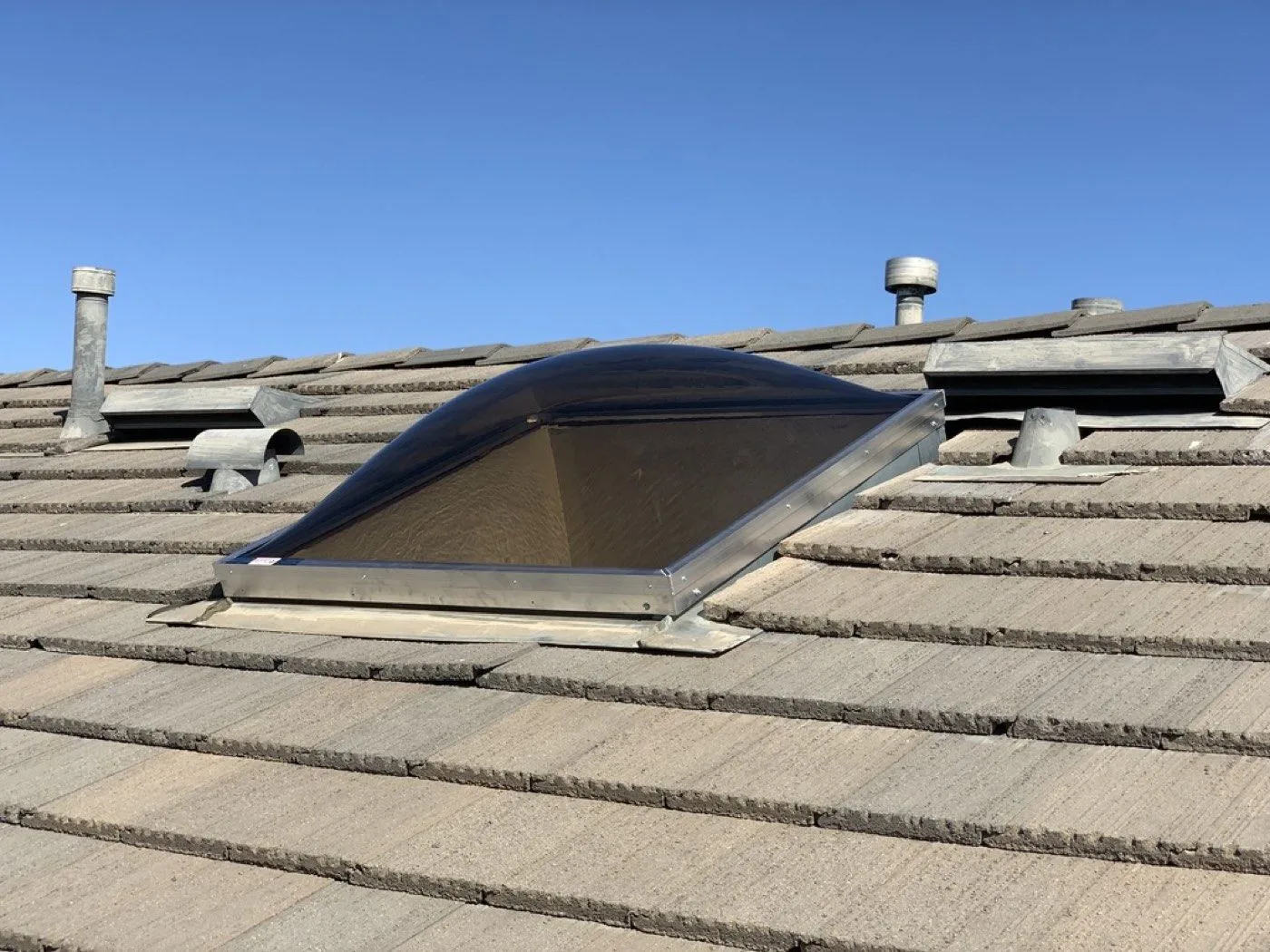
Most of the skylights we replace were installed twenty, thirty, even forty years ago. They did their job for a long time. Now the acrylic has yellowed, the seal has failed, or the unit cracked, and the light coming through looks tired and the rain is finding its way in. That is most of what we do. We are a glazing company, and replacing failed skylights is the core of the work.
How a skylight actually fails
A skylight is a sealed unit sitting on a curb on your roof. It fails in a few predictable ways, and almost none of them mean your whole roof is bad.
The acrylic yellows and goes brittle
Older domes are acrylic or polycarbonate. Decades of UV exposure turn them yellow, then cloudy, then brittle. The light that used to pour in now looks dim and dirty. Old, brittle acrylic doesn’t need much encouragement to crack. Age and sun exposure do most of the work.
The seal between the glass fails
Insulated glass units have two panes with a sealed space between them. When that seal fails, moisture gets in and you see fog or condensation between the panes that you cannot wipe away. Once a seal is gone, the unit is done. On custom architectural skylights that can be field-disassembled, we can sometimes replace just the failed glass instead of the whole unit. Factory-sealed skylights, VELUX units and dome skylights, cannot be opened this way, the glass and acrylic come sealed into the frame at the factory. More on glass reseal and replacement here.
The unit cracks or the dome splits
Age, impact, foot traffic from other trades on the roof, or a tree limb. A cracked skylight is both a leak and a safety issue, and it is time to replace.
What we replace it with
This is where the conversation happens at your house. There is no single right answer, it depends on the opening, the roof, the light you want, and the budget.
- Glass or acrylic. Glass is clearer, lasts longer, more energy efficient, and better at blocking outdoor noise. Acrylic and polycarbonate domes cost less and are lighter. Modern versions of both do not yellow the way older plastic did. We install all three and we will tell you honestly which makes sense for your situation.
- Fixed or venting. A fixed skylight is sealed glass for light only. A venting skylight opens to let heat and moisture out and fresh air in, manual or motorized. Bathrooms and kitchens often want venting.
- Low-E, tempered, and laminated. Low-emissivity coatings cut heat gain and UV fading. All the glass we install overhead is tempered over laminated. California requires laminated glass on the interior side so that if a pane breaks it holds together rather than falling into the room. The tempered layer on the outside handles impact. We spec the right combination for the orientation and the room below.
A typical job: An older home in the Valley with two cloudy acrylic domes over a hallway, both yellowed and one cracked at the corner. We came out, looked at the roof and the existing curbs, and replaced both with new units sized to the same openings. One day on the roof. The hallway went from dim to bright.
What about the curb and the roof?
In most replacements the existing curb is fine and we set the new unit right onto it. When a flat glass skylight needs a little pitch so water runs off instead of pooling, we can build or pitch a curb to handle that. What we do not do is reroof your house. If your actual problem is the roof rather than the skylight, we will tell you, and that is a job for your roofer.
Repair, replace, or reseal?
Not every skylight needs full replacement. Sometimes the glass can be replaced in the existing frame. Sometimes a reseal buys years. Sometimes the honest answer is that the unit is past saving. We walk you through it before you spend anything. See repair vs. replace if you want to think it through first.
What it typically costs
A standard-size replacement, like swapping a common 2×4 VELUX glass unit, usually runs $800 to $900. That is the most common job we do, and it is quick because it is one trade, one visit.
Acrylic domes are about 10 to 15% cheaper than glass in standard sizes, and considerably cheaper than glass in custom sizes. Going from a fixed skylight to a venting one, especially a solar-powered operable unit, is a real jump, often 3 to 4 times the cost of a fixed glass skylight, the operator hardware and motor add up.
How it goes
You call, we get the details and set an appointment, usually within a day or two. We come look at the roof and the skylight in person and talk through your options. You get an estimate within a few days. Once you approve it and leave a deposit, we order your skylight. Standard sizes take a couple weeks to arrive, custom takes longer. When it comes in, we schedule the install, and the install itself is usually a single day.